Drain Cleaning
When Does a Slow Drain in Annapolis Need Professional Drain Cleaning?
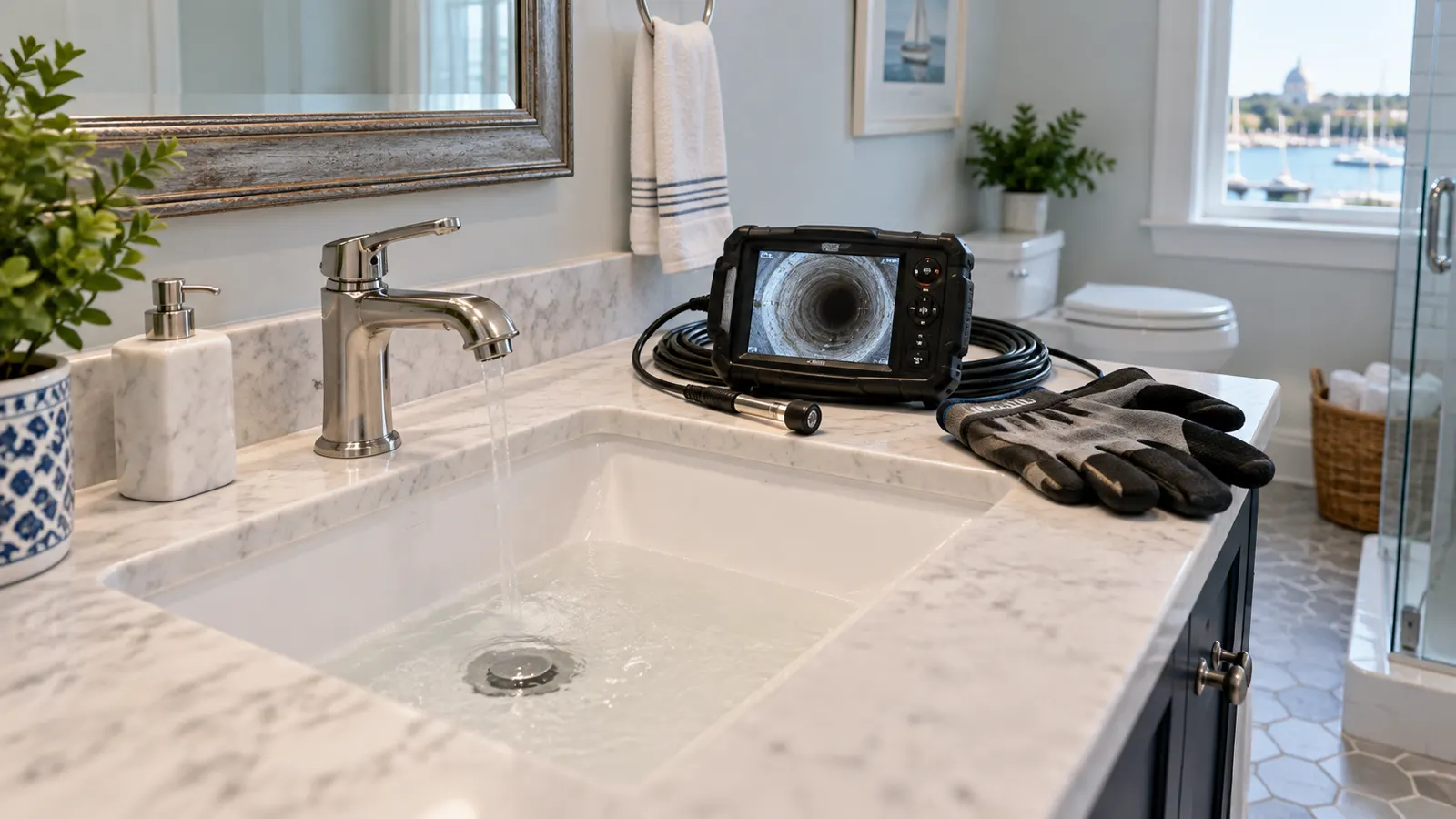
One sink that empties a little slower than it used to is an annoyance. The same sink slowing down again three weeks after it cleared, or two fixtures slowing down in the same week, is a different kind of information. Professional drain cleaning is the answer to the second situation more often than the first.
The useful question is not how slow the drain is. It is whether the slowness is isolated or part of a pattern. This guide explains how to tell those apart from safe observation, when to stop and call, and what to expect when you request service.
Single fixture or a pattern
Start by sorting what you are seeing into one of two buckets.
A single-fixture observation means one sink, tub, shower, or toilet drains slowly while every other fixture in the home behaves normally. The problem appears at one location and stays there.
A recurring or multi-fixture observation means either the same fixture slows down repeatedly over weeks or months, or more than one fixture shows the problem at the same time. It may also mean one fixture reacts when a different one is used.
These two patterns are not the same situation with different severity. They describe different scopes, and the second one is the one that tends to need professional attention sooner.
What a single slow fixture tells you
When exactly one fixture is slow and nothing else in the house is affected, the observation is limited to that fixture and the piping serving it. That is genuinely useful information, and it is worth recording carefully.
Note which fixture, how long it has been slow, whether it is getting worse, and whether it ever drains normally. Note whether the fixture has a visible stopper or strainer, and whether water backs up or just moves slowly.
What a single slow fixture does not tell you is the cause. Slow drainage at one location can come from several different conditions, and appearance alone does not separate them. Do not treat one slow sink as proof of a main line problem, and do not treat it as proof of a minor one either.
Observations that point to something recurring
Repetition changes the picture. When a fixture clears and then slows again, the pattern is the finding, not any single episode.
Track a few things across episodes: how long normal drainage lasted before it slowed again, whether the interval is shortening, whether more fixtures are involved each time, and whether anything was done between episodes.
A drain that slows again on a shortening cycle is telling you that whatever produced the first episode is still present. Repeating the same short-term response tends to reset the clock rather than resolve the condition.
Write the dates down. Two months of notes is far more persuasive than a memory of "it keeps happening."
When more than one fixture is involved
Multiple fixtures showing drainage problems at once is the observation that most reliably calls for professional drain cleaning rather than watching another week.
Record which fixtures are affected and which are normal, whether they are on the same floor or in the same area of the home, and whether one fixture reacts when another is used. Note anything unusual you can see or hear from a safe position, and note any odor.
Also record whether a toilet is involved, and whether anything backs up at a low fixture such as a basement or ground-floor drain. Those details matter to the scope of the evaluation.
Do not decide what the pattern means. Record it accurately and let it be evaluated at the property, where the installed piping and the conditions can actually be confirmed.
Safe escalation and what to stop doing
Escalating safely mostly means not making the situation harder to evaluate.
Do not pour chemical drain products into the fixture, and never combine two products. Do not run a cable or auger into a drain or cleanout. Do not open, remove, or reassemble drain piping, traps, or cleanouts. Do not attempt any work on a sewer line or a septic component. Do not keep running water into a fixture that is backing up, and do not flush repeatedly to see whether it clears.
The reason is not only risk to the piping. These situations sit close to standing water, electrical equipment, and possible sewage exposure, and the same fixture can be configured differently from one home to the next.
Stop and seek prompt help right away if wastewater is backing up into the home, if water is reaching electrical equipment, if there is significant sewage exposure, if drainage has stopped entirely, or if you suspect gas. Those are not situations to monitor for another day.
What to expect when you request drain cleaning
Requesting service is a property-specific evaluation, not a remote diagnosis. Nobody can tell you from a phone call what is in your drain.
Expect to be asked for the observations described above: which fixtures, what pattern, how long, what changed, and whether anything has already been tried. Expect the conditions to be confirmed on site before any method is chosen, because the appropriate approach depends on the piping, the access available, and what the evaluation finds.
Expect access to matter. Clear the cabinet under the sink, note where the fixture sits relative to finished ceilings below, and mention a crowded utility area or a hard-to-reach basement.
Expect an explanation of what was found, not just what was done. That explanation is what tells you whether the condition is likely to return. You can review the drain cleaning services Heidler Plumbing provides in Annapolis before you schedule.
Keep a short record between visits
The single most useful thing a homeowner can do for a recurring drain problem is keep a dated log. It takes a minute per entry.
- Date the slowness was noticed
- Which fixtures were affected, and which were normal
- Whether it backed up or only drained slowly
- What was running at the time
- Any odor, sound, or visible condition
- Date it returned to normal, and what was done
After two or three entries the pattern is visible in a way it never is from memory. That record turns "it keeps happening" into a timeline someone can work from, and it is the difference between another short-term response and an evaluation aimed at the actual scope.
Request drain cleaning in Annapolis
A single slow fixture is worth watching and writing down. A slow drain that keeps coming back, or one that arrives with company at a second fixture, is worth an evaluation at the property.
Heidler Plumbing serves Annapolis, MD. Bring your dated notes and the list of affected fixtures, and contact Heidler Plumbing to schedule drain cleaning service.
Keep reading
Related plumbing advice
Plumbing Advice
Carbon Monoxide and Gas Appliances in Annapolis, MD: Why Backdrafting Happens
Read articleHeating & Gas
Boiler Low Water Cutoff in Annapolis, MD: Why It Trips and What It Protects
Read articleHeating & Gas