
Plumbing Advice
What to Gather Before Scheduling Plumbing Service in Annapolis
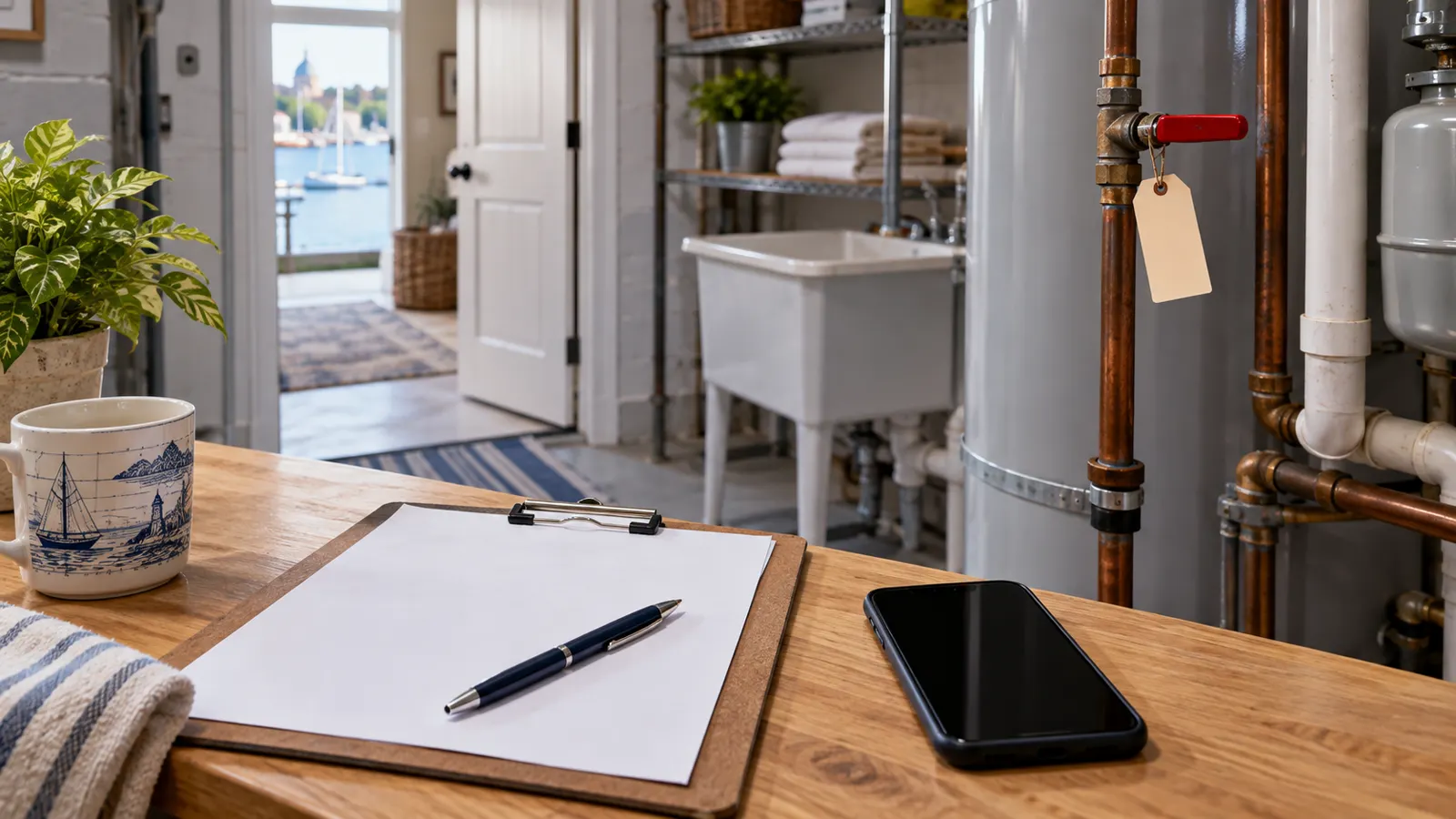
Most of what a plumber needs to know happened before anyone was called. The drip started on a Tuesday, it only shows up when the washing machine drains, and the stain under the sink has been there for a month. Nobody wrote it down, so the details arrive as guesses.
Gathering a short record first makes Annapolis plumbing services work better for you. This guide covers what to write down: the symptom, the affected fixtures, the timing, the visible conditions, and photos taken only where it is safe to stand. It does not diagnose anything and does not give repair steps, because neither can be done from a description.
Describe the symptom in plain language
Start with what you notice, not what you think is causing it. Plain observations survive scrutiny. Conclusions do not.
Useful: "The kitchen faucet runs at about half its normal flow." "There is water on the floor beside the water heater." "The upstairs toilet takes two flushes." Each of those is something that can be checked at the property.
Less useful: "The main line is clogged." "The pressure regulator failed." "There is a slab leak." Those are conclusions, and if they are wrong they send the visit in the wrong direction.
Write one or two sentences per symptom. If several things are happening, list them separately rather than merging them into one story.
List every fixture that shows the problem
The pattern across fixtures is one of the most useful pieces of information you can supply, and it takes nothing more than a walk through the house.
Go room by room. For each sink, tub, shower, toilet, laundry connection, outdoor spigot, and any appliance connected to water, note whether it behaves normally or not. Be specific about which side is affected: hot only, cold only, or both.
Then note the fixtures that are fine. A problem at one fixture while everything else behaves normally is a different situation from a problem that shows up at several fixtures at once. Do not decide what that difference means. Just record it accurately.
Record the timing
Timing tells a story that a single snapshot cannot. Four questions cover most of it.
- When did it start? A date, or the closest you can get.
- Is it constant or intermittent? Does it happen every time, or only sometimes?
- What is running when it happens? A shower upstairs, the dishwasher, the washing machine, an outdoor hose, or nothing at all.
- Is it changing? Getting worse, staying the same, or coming and going.
Add anything that changed at the property around the same time. New appliance, work done by another trade, a fixture replaced, a long vacancy, or a seasonal shift. You do not have to connect those events to the symptom. Just note that they happened.
If the problem has occurred before, write down roughly when and what was done about it. Prior history at the same address is context that is easy to lose.
Note the visible conditions around the area
Look at what surrounds the problem from a position where you are standing safely and not touching anything.
Record visible water and whether it is active right now or dried. Note staining, discoloration, warped or soft flooring, peeling paint, a musty smell, mineral-like residue on fittings, corrosion on accessible pipe, or an unusual sound. Say where each one is relative to the fixture.
Also note the conditions that will affect the visit. Whether the area is finished or unfinished, whether the fixture sits above a finished ceiling, whether the utility space is crowded, and whether the shutoff you know about is reachable.
Do not remove panels, open access covers, operate unfamiliar valves, or move heavy items to get a better look. If water is spreading toward electrical equipment, if the structure feels unsafe, if you suspect gas, or if there is significant sewage exposure, stop gathering information and seek prompt qualified help or the appropriate utility or emergency guidance instead.
Take photos only where it is safe
Photographs carry detail that descriptions lose, but only the ones you can take without putting yourself somewhere you should not be.
Take a wide shot of the room, a closer shot of the fixture or equipment, and a shot of any stain, puddle, or corrosion you described. If an equipment label is already visible and readable from where you stand, photograph it. If it is behind, under, or above something, skip it.
Do not photograph inside a panel, behind a cover, or from a ladder in a wet area. Do not reach into a crowded utility space to line up a better angle. A missing photo is a small gap. An injury is not.
Name the files or add a caption with the room and the date. A folder of unlabeled photos is harder to use than three labeled ones.
What to leave to the plumber
There is a line between gathering information and trying to solve the problem, and the second one tends to make the first one useless.
Do not pour products into a fixture or drain, and never combine two products. Do not reset, adjust, or disassemble equipment to test an idea. Do not tighten fittings, replace parts, or apply sealant based on a presumed cause. Do not change a safety-related component.
Two reasons. The first is safety: plumbing work sits close to hot water, gas, and electricity, and the same fixture can be configured differently from one home to the next. The second is evidence. An altered condition is harder to evaluate than the original one, and a symptom that stops after an adjustment has not been explained, only hidden.
If someone already used a product or changed something before you started keeping notes, write that down and share it. It is safety information, not a mistake to hide.
A pre-visit record you can copy
Bring one page with these fields filled in:
- Symptom, in one or two plain sentences
- Fixtures affected, and fixtures confirmed normal
- Hot side, cold side, or both
- Date it started, constant or intermittent, and whether it is changing
- What is running when it happens
- Anything that changed at the property recently
- Visible conditions and where they are
- Prior occurrences and what was done
- Access notes: parking, stairs, pets, who will be home
- Safe photos, labeled by room and date
Keep it factual. A record of what you observed is more useful than a theory about what is wrong, and it is the part of the visit only you can supply.
Schedule plumbing service in Annapolis
Once the page is filled in, the conversation can move straight to the property-specific evaluation that actually settles the cause. Heidler Plumbing serves Annapolis, MD, and you can review the residential plumbing services available to Annapolis homes before you call.
Bring your record and your photos. Contact Heidler Plumbing to schedule plumbing service in Annapolis.
Keep reading
Related plumbing advice
Plumbing Advice
Carbon Monoxide and Gas Appliances in Annapolis, MD: Why Backdrafting Happens
Read articlePlumbing Advice
Gas Fireplace Pilot Light Keeps Going Out in Annapolis, MD: Why It Happens
Read articlePlumbing Advice